Why the Sun erupts
Module 1 showed what a CME is. This is the machine behind it: where a billion tons of launch energy comes from, and what finally lets it go. Then a real one, replayed.
The idea
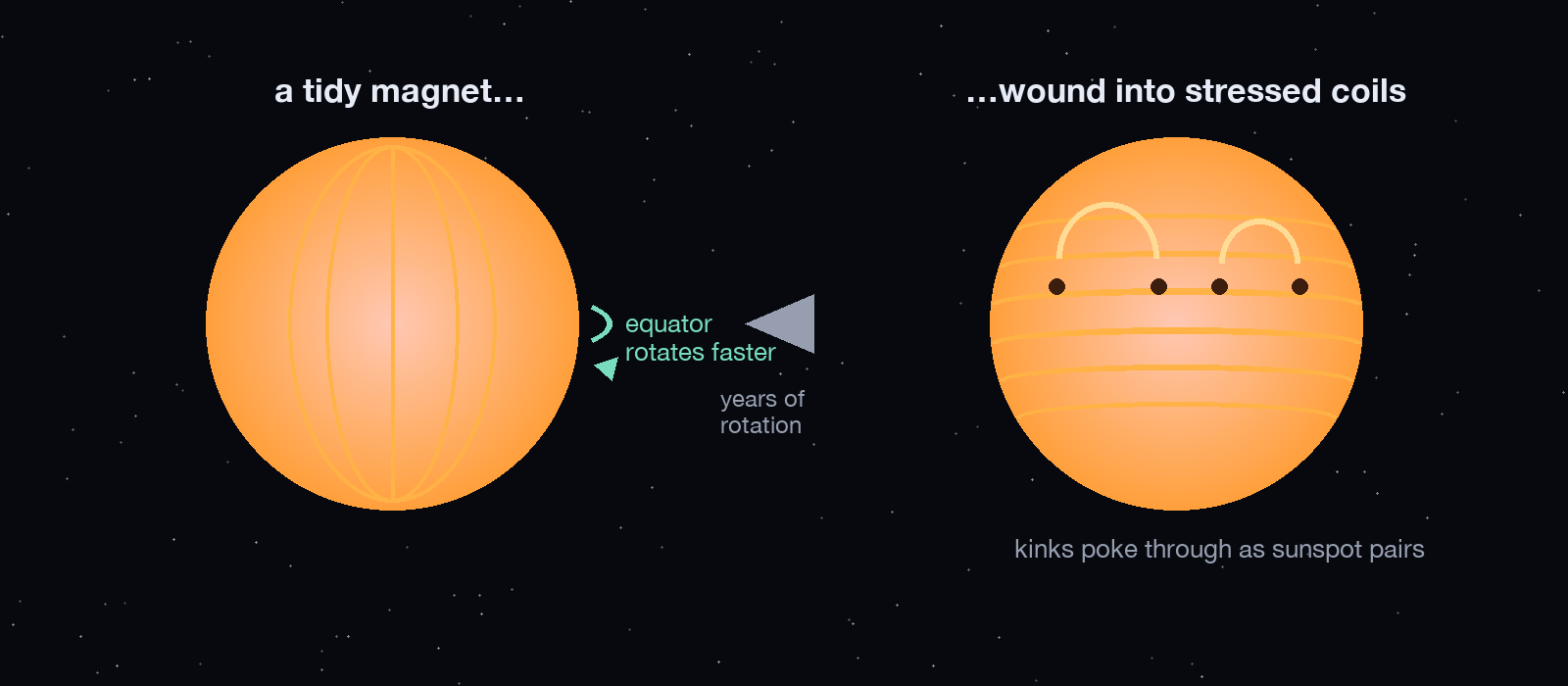
The Sun isn't solid, so its equator spins faster than its poles. The magnetic field is frozen into that plasma, so a tidy pole-to-pole field gets dragged, stretched and wound like a spring, year after year. Where the wound-up field bursts through the surface, its footpoints are sunspots.
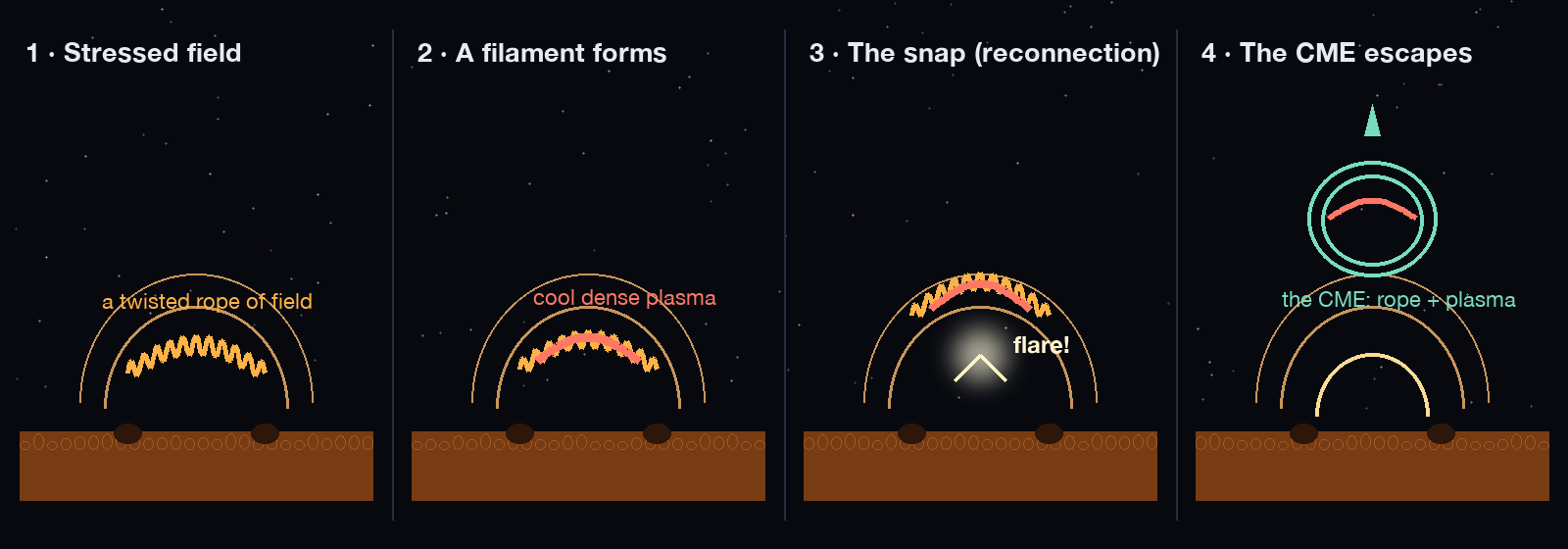
A rope of twisted field carrying that much stress can't hold forever. When it is pushed past its limit, field lines snap and reconnect into a simpler shape. That snap is one process with two signatures: the flash is the flare, at Earth in eight minutes; the escaping bubble of plasma and field is the CME, at Earth in one to three days.
Your call
Play from the flash. How many minutes pass before the new wedge appears at the Sun?
What happened
The gap is real physics, not a delay in the data. The flash is the reconnection itself. The cloud has to accelerate out through the corona before coronagraphs can measure it, and coronagraphs pick it up from about 2 solar radii. NASA's catalog time-stamps the front at 21.5 solar radii, about 15 million km out, which is where the model takes over.
The pairing isn't automatic either. A confined flare flashes under a strong overlying field that holds the cloud in, so no storm follows. A stealth CME slips away with almost no flash, which is a forecaster's least favorite kind. That is why "X-class flare!" in a headline tells you almost nothing about storms by itself.